
State‑of‑the‑art atomistic quantum transport for next‑generation nanoelectronic devices
AtomX, is a high‑performance dissipative DFT‑NEGF simulator with unique capabilities in terms of efficiency, speed and memory footprint. It brings first‑principles accuracy together with affordable simulations including scattering —so you can explore realistic devices with up to millions of atoms and go from materials to I‑V characteristics with confidence.
AtomX is the fruit of over 20 years of advanced research in quantum transport and device physics. It benefits from the best technologies optimized over the years and validated over a wide range of devices and material systems.
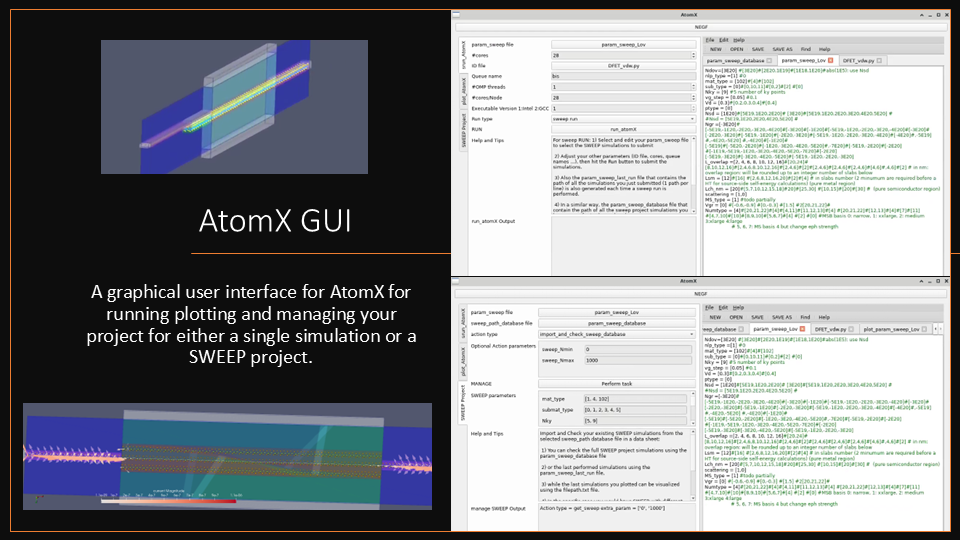
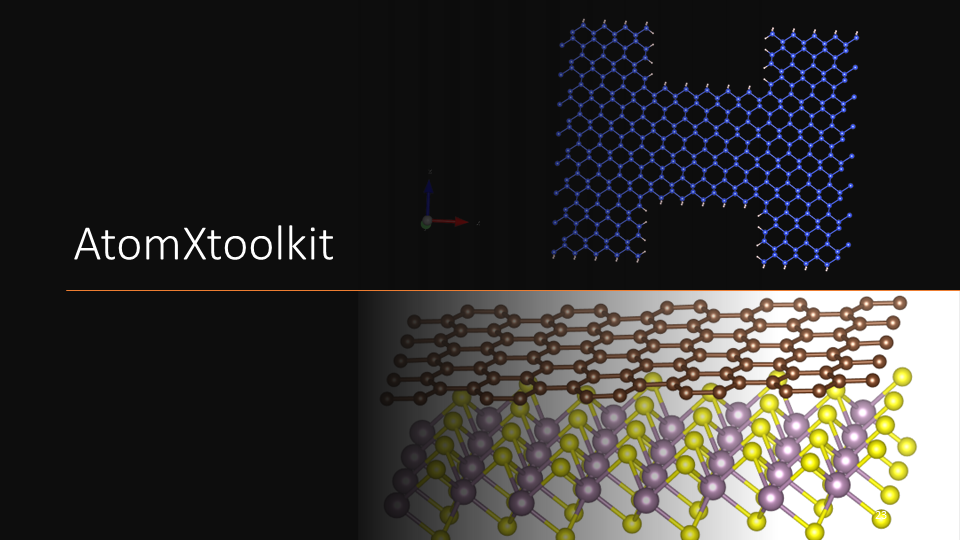
AtomX is packaged with its companion Tool Kit (AtomXtoolKit) for easy and automated DFT-supercell building and optimization and AtomX GUI, a powerful integrated graphical user interface for automated parameter studies and post‑processing.
NEWS
and EVENTS :
Meet us at SISPAD
2026 in Kumamoto Japan (September 28 - 30) and do not miss our
talk:
We will be present at IEDM
2026 in San Francisco, CA (December 12 - 16). Do not miss our
talk on Tuesday 15 :
AtomX: from atoms to device‑level insight
AtomX combines ab‑initio DFT‑based Hamiltonians with a high-performance, dissipative self‑consistent NEGF solver to predict transport with high fidelity—covering quantum confinement, tunneling, and scattering by construction.
Use our accelerated DFT‑NEGF implementation to get uncompromised ab-initio accuracy with unmatched speed, e.g., for novel materials and interfaces. Run parameter sweeps and get results on the same day.
Don't need ab-initio accuracy? AtomX also offers DFTB, tight‑binding or effective-mass NEGF so you can choose the best speed vs. accuracy trade-off for your application.
Evaluate materials, contacts, stacks, and device geometries—then deliver clean I–V and band/DoS analyses.
Benefit from the best technologies developed and tested over decades of cutting-edge research in quantum transport and device physics.

Key features & benefits
Ab‑initio accuracy
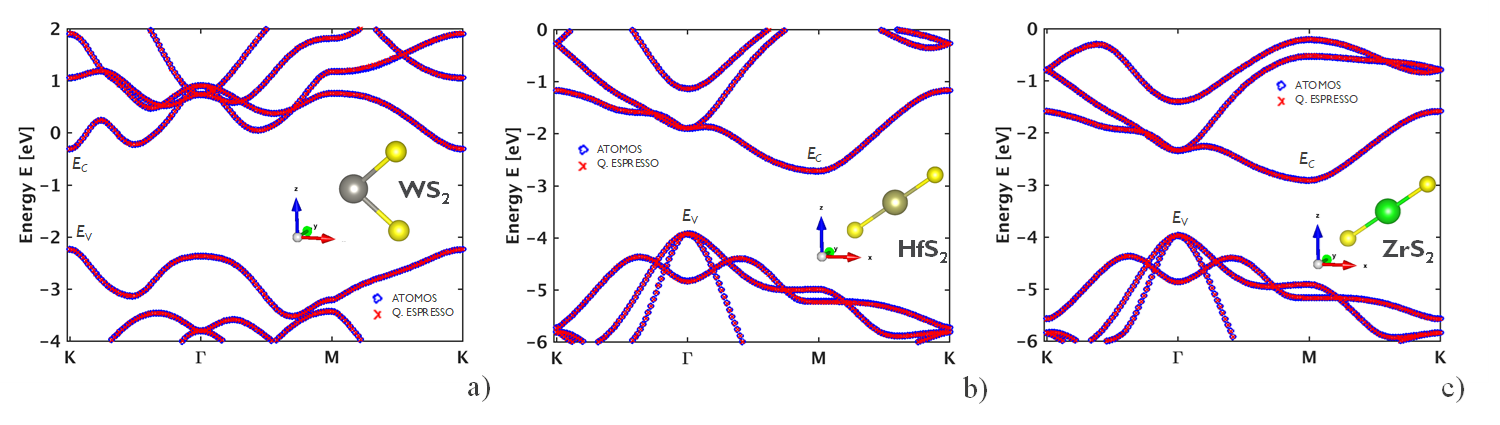
DFT‑based Hamiltonians (plane‑wave + Wannier or localized orbital) feed directly into NEGF—parameter‑free for new materials.
Interfaces & stacks
Model explicit contacts and van der Waals heterostructures to optimize SBH and tunneling.
Speed & scale
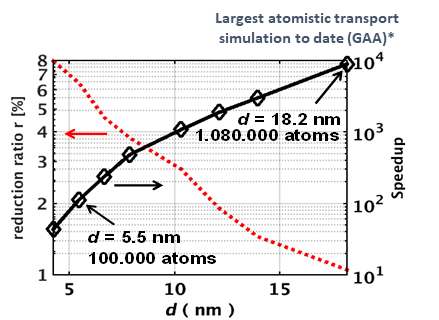
Massively parallel solvers, memory‑lean data structures, and mode‑space acceleration for practical runtimes with large devices up to millions of atoms.
Scattering included
Accurate electron–phonon scattering with self‑consistent Born approximation; DFPT‑derived options available.
Automation & sweeps
AtomX GUI: a powerful integrated graphical user interface (also Python interface with SWEEP library) for automated parameter studies and post‑processing.
AtomXtoolkit
Automate supercell creation/relaxation/merging and integrate with common DFT packages.
Technology that enables results
- High‑performance core: hybrid MPI/OpenMP C++ solvers with sparse, memory‑lean data structures.
- Self‑consistent convergence: predictor–corrector Poisson‑NEGF methods and smart adaptive damping for robust solutions.
- Acceleration: mode‑space NEGF workflows delivering typical 100× speedups on suitable supercells.
- Scattering physics: state-of-the-art self‑consistent Born formalism, with options from isotropic deformation potentials to DFPT‑derived full matrices.
- Load balancing: recursive adaptive energy‑grid with master–slave scheduling to catch resonances efficiently
Where teams use atomX
2D material transistor screening
Quantify material choice, layer‑count, orientation, and channel‑length trade‑offs; assess mobility and current to shortlist candidates.


2D materials screening (ION vs L, mobility, DoS).
Explicit contacts & interfaces
DFT-NEGF transport across metal /semiconductor interfaces enabling efficient material screening and contact engineering.

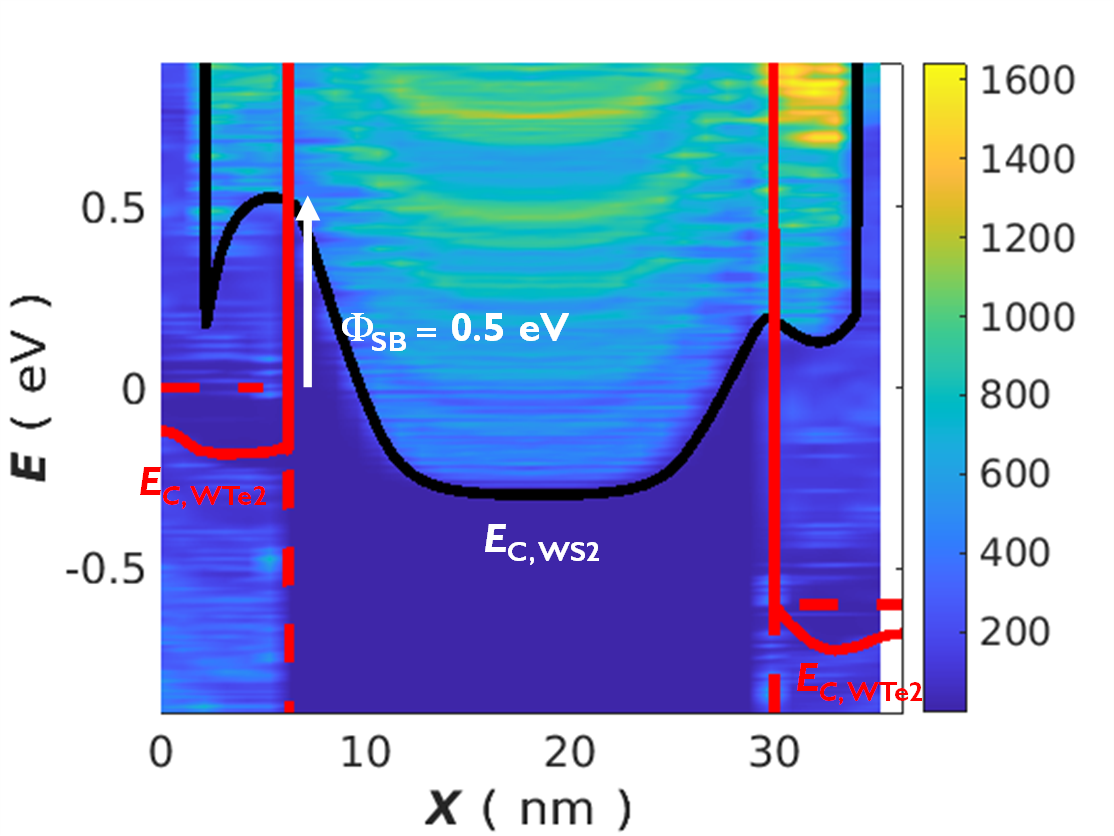
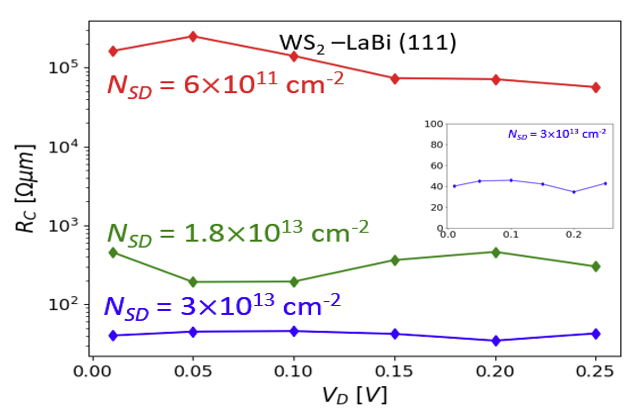
Interface transport.
Sun, Z., Afzalian, A., Wu, P. et al. Low-resistance contacts for p-type monolayer tungsten diselenide transistors using metallic layered Nb0.3W0.7Se2. Nat Electron 9, 358–366 (2026)
Novel device concepts
Explore Dirac/"cold source" FETs, van der Waals TFETs, or devices based on topological materials; study fundamental physics, sensitivity to scattering and materials.



Cold source Dirac FET study.
A. Afzalian et al. Advanced DFT–NEGF Transport Techniques for Novel 2-D Material and Device Exploration Including HfS2/WSe2 van der Waals Heterojunction TFET and WTe2/WS2 Metal/Semiconductor Contact, IEEE Transactions on Electron Devices,68, 11 (2021)
CNT‑FET fundamentals
Hybrid‑functional DFT for accurate bandgaps analyze BTBT limits (IMIN) and ION vs. VDD.

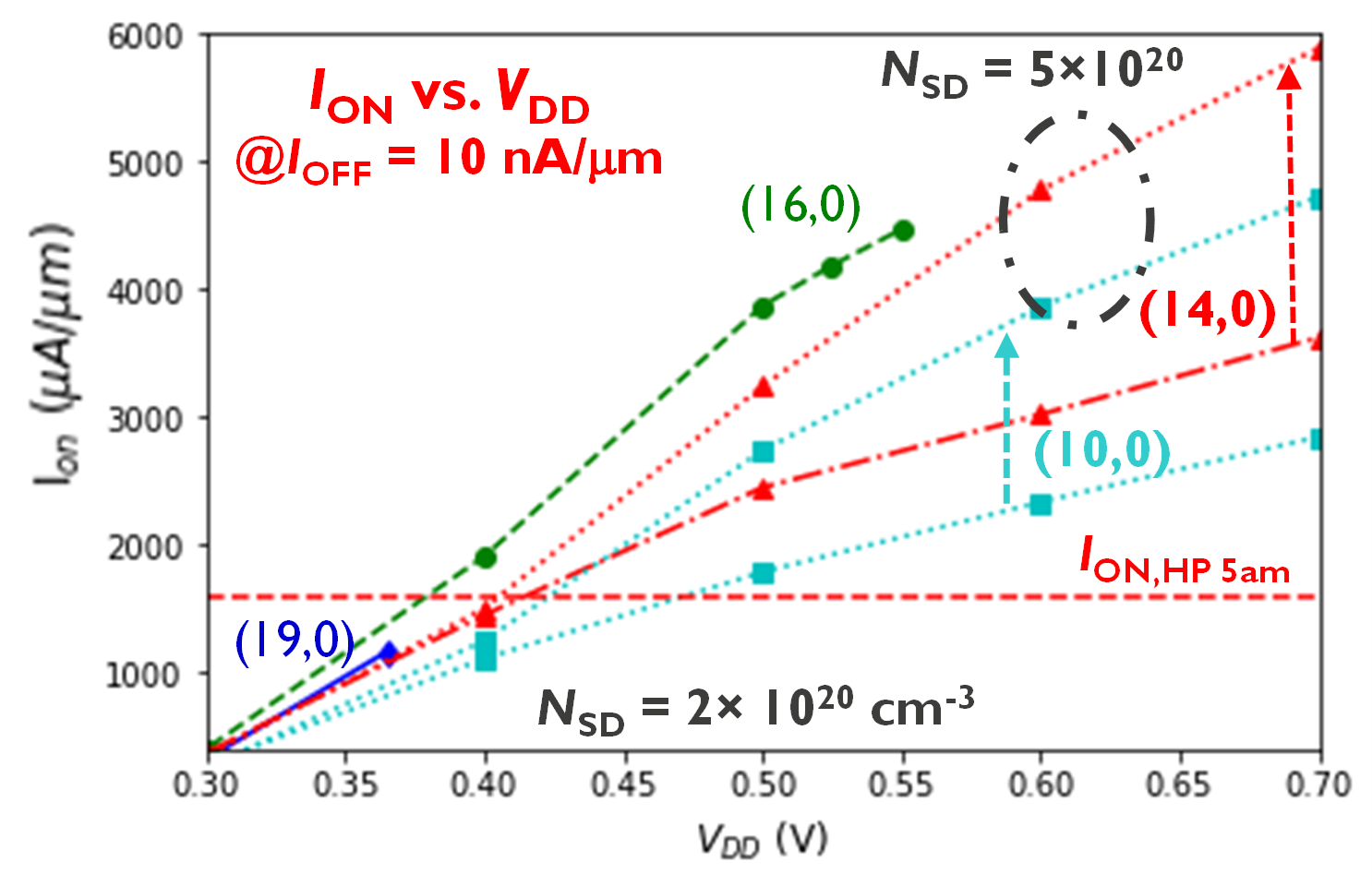
CNT‑FET fundamentals.
A. Afzalian, Ab-Initio-NEGF Fundamental Roadmap for Carbon-Nanotube and Two-Dimensional-Material MOSFETs at the Scaling and VDD Limit, SISPAD 2025
BioFET simulations
Include ions in solution and electrode models to study single‑molecule detection (e.g., DNA sensing).
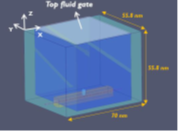

BioFET sensing behavior.
Afzalian A, Flandre D. Ultra-Scaled Si Nanowire Biosensors for Single DNA Molecule Detection. Sensors (Basel). 2023 Jun 7;23(12):5405.
Limit of scaling of Si Nanosheets
Surface‑roughness‑driven variability and short‑channel effects for ultrascaled Si/Group‑IV.
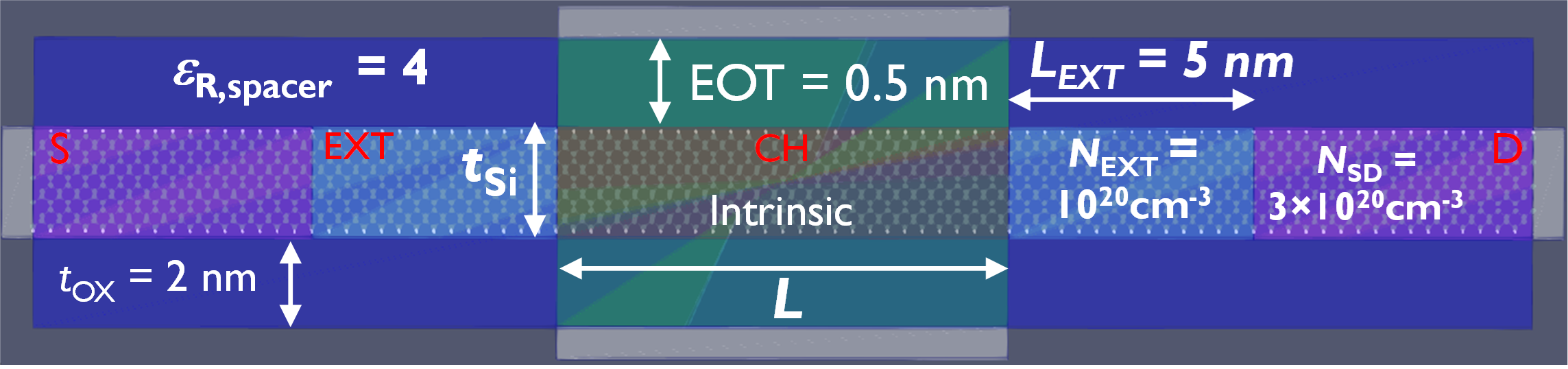
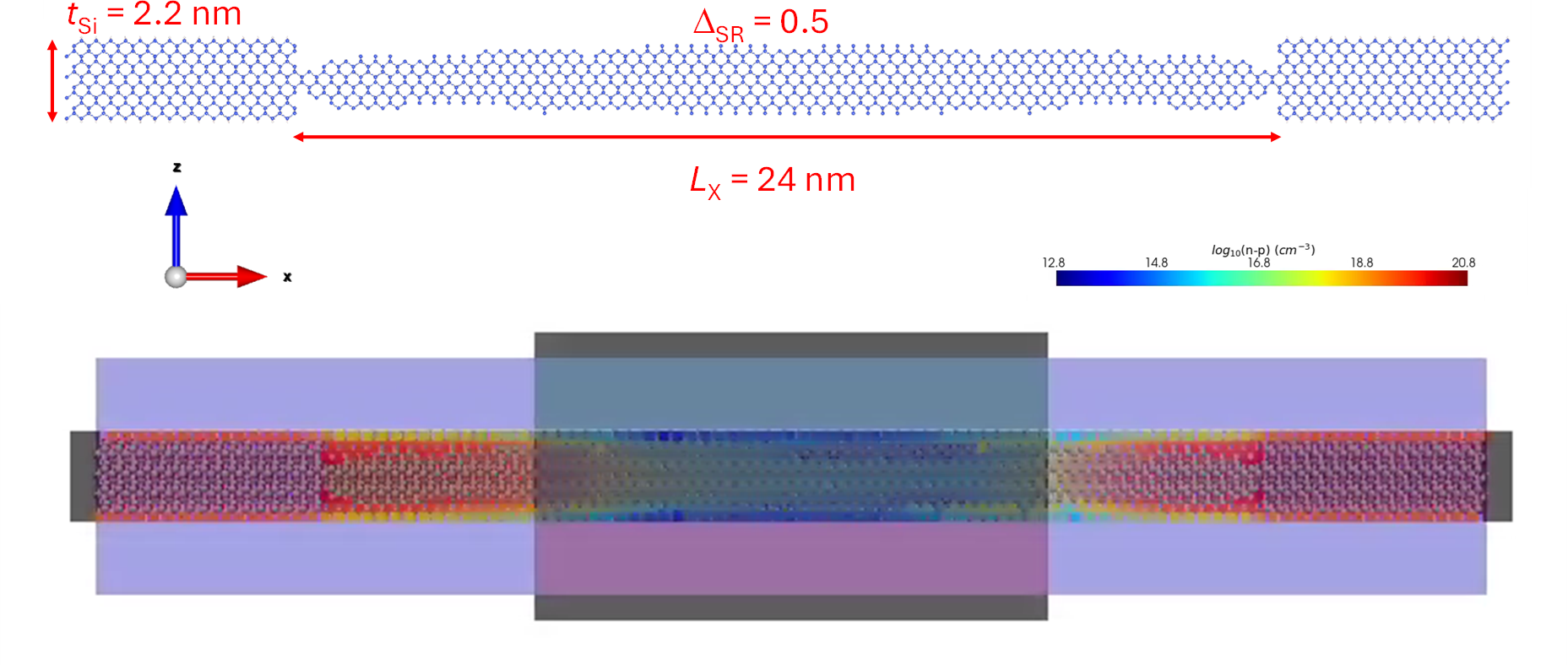
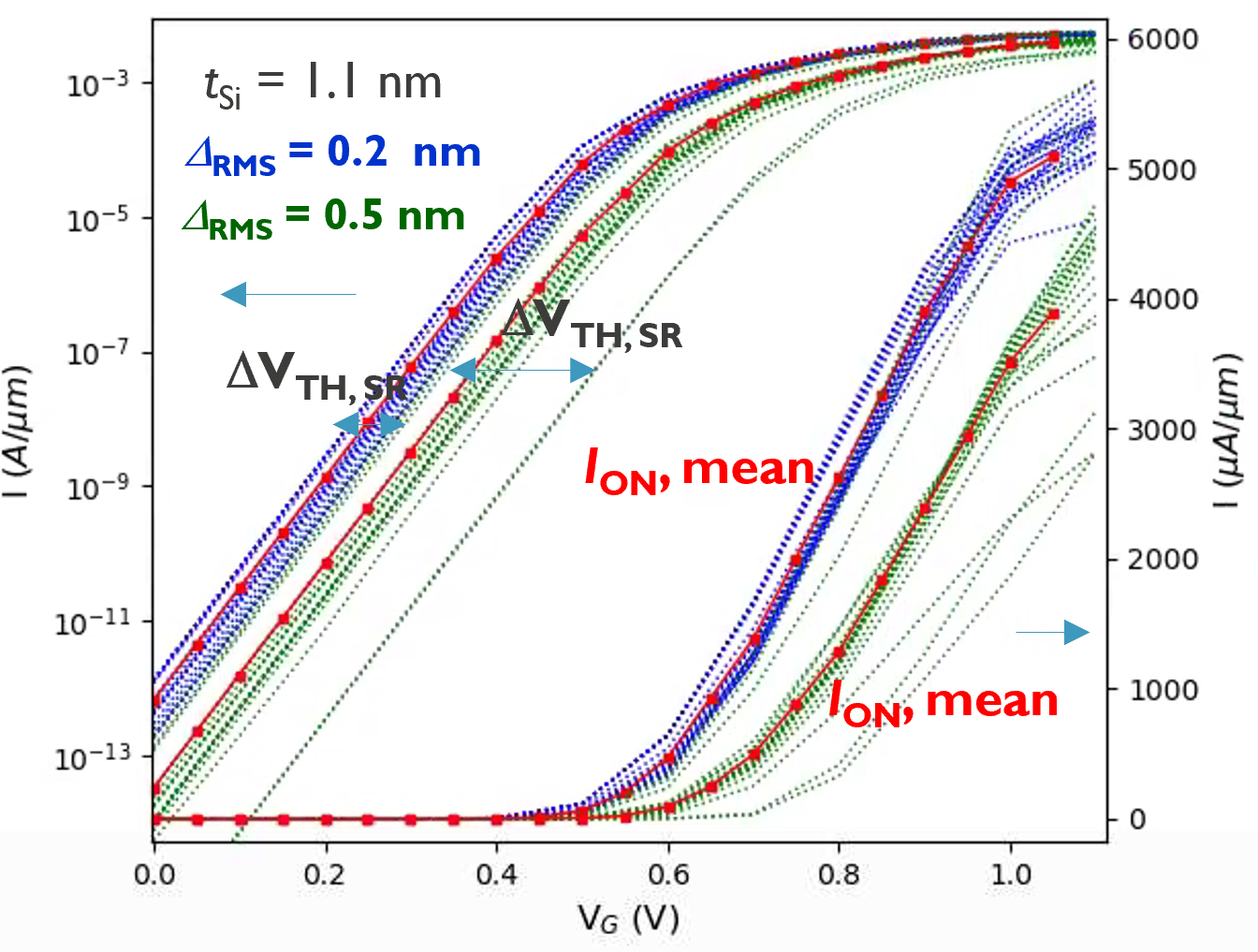
Surface roughness & variability.
Scaling Limit of Ultra-Thin Si Nanosheets: Insights from DFT-NEGF Transport and Experiments, iedm 2026
Performance & validation
- Agreement with experiments: AtomX has shown consistent parameter-free agreement with experiments on a wide range of materials and devices. The shown figure from our recent Nature Electronics publication highlights close match between simulations and measurements for the metal-semiconductor contact resistance of a WSe₂ device.
- Scale & efficiency: designed for realistic devices; publications show million‑atom capability and efficient ab‑initio transport at scale.
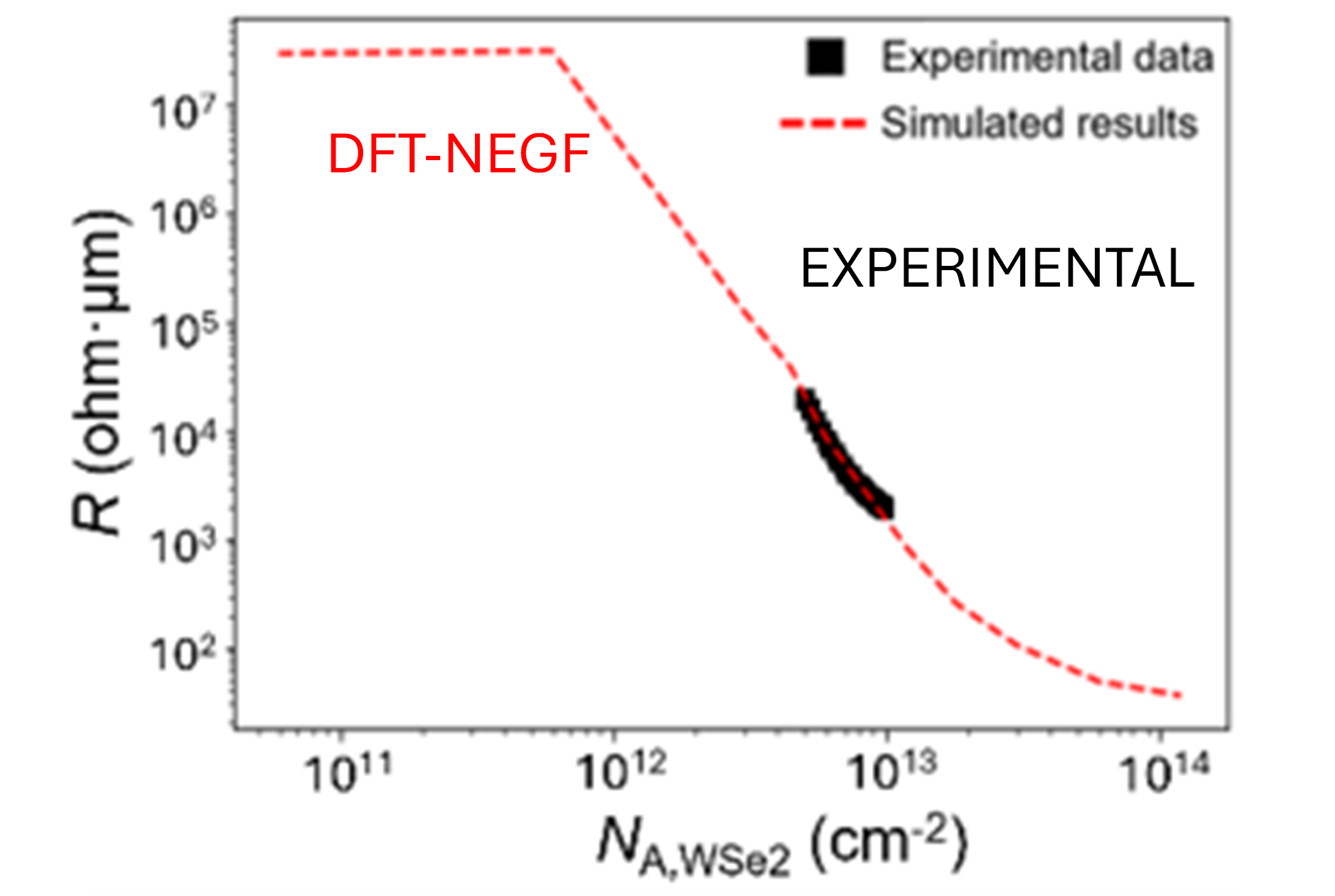
Experiment ↔ Simulation agreement (WSe₂ contacts).
Fits your workflow
- DFT sources: plane‑wave (e.g., QE, VASP) with Wannierization, or localized orbital DFT (e.g., OPENMX, CP2K) without Wannierization.
- Automation: AtomXtoolkit to build and relax supercells; AtomX GUI A graphical user interface for running, plotting and managing your SWEEP projects.
- From atoms to I–V: assemble material building blocks into full device geometries and run transport for clean results and plots.
See AtomX in Action
Ready to evaluate AtomX for your materials and devices, discuss your use case, or ask about licensing? Request a live demo and let us walk you through our workflow.
Prefer to share slides or device targets first? We’ll suggest a minimal validation plan and next steps.
What to expect
- Live discovery of capabilities and design flow.
- Guidance on use case, models and runtime/scale expectations.
- Q&A with our team.